Serial Port at the Edge
The edge gateway opens an RS-485 or RS-232 port, built in or through a USB converter, and polls each device on its own address.
Read meters, drives, controllers and instruments that speak over RS-485 or RS-232 serial lines. The edge gateway holds the serial port and polls each device, so the cabling never has to reach the internet.
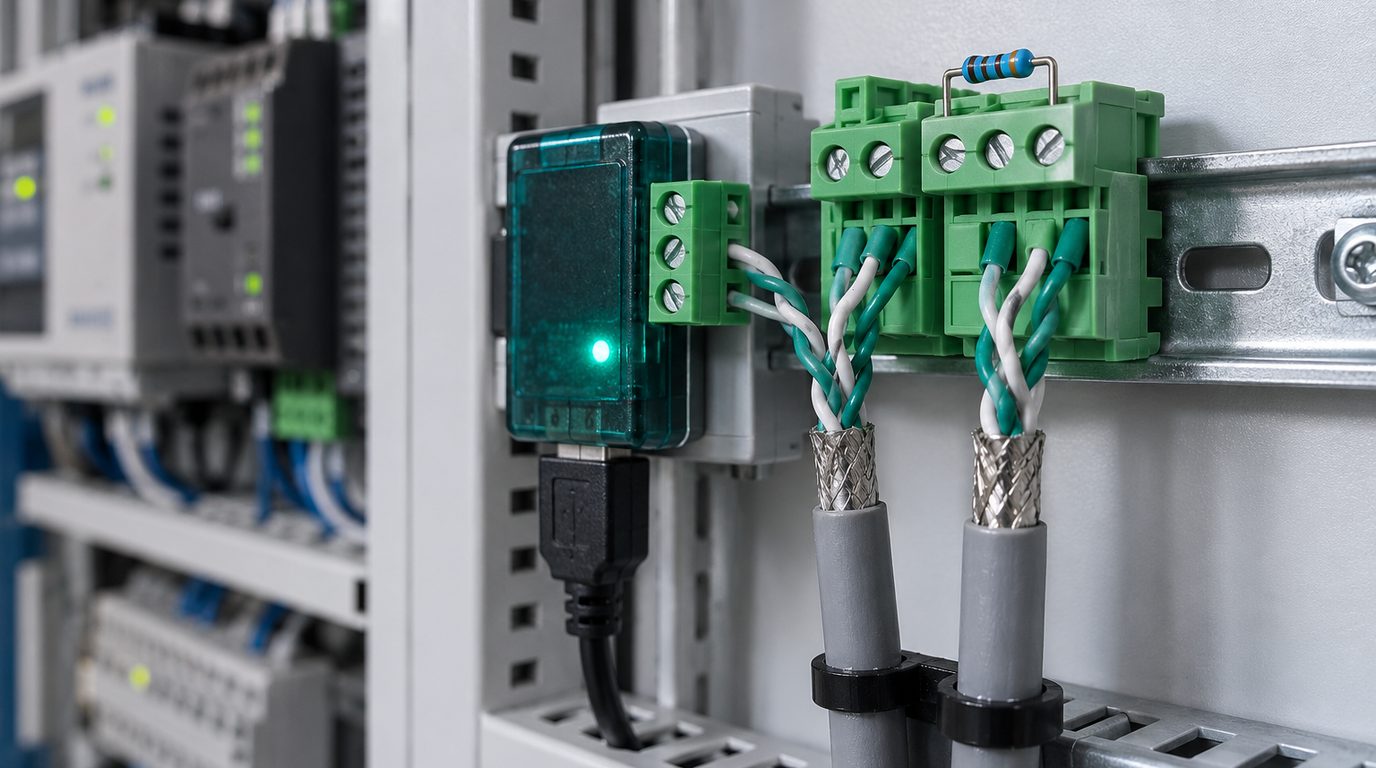
Serial is the oldest and most common way to wire field equipment. RS-485 is a differential multidrop bus where many devices share one twisted pair, and RS-232 is a short point-to-point link. Neither defines what the bytes mean: Modbus RTU, BACnet MS/TP and many vendor protocols ride on top. Because these lines stay on site, an edge gateway with a serial port or a USB converter does the reading, and IoTServa receives the result as normalized tags.
Native Address
Normalized Tag
site.plant.mcc-1.motor-12.run-current
14.2A
The edge gateway opens an RS-485 or RS-232 port, built in or through a USB converter, and polls each device on its own address.
Several devices share an RS-485 trunk. Requests are grouped and timed per line so a slow trunk stays responsive.
Pick the protocol on top, usually Modbus RTU, and apply a device profile for register addresses, scaling and units.
If the uplink drops, readings are held on the gateway and sent in order when the connection returns.
Serial settings must match on both ends: baud rate, parity and stop bits. A wrong setting looks like a dead device.
Wire an RS-485 trunk as a daisy chain with short stubs, terminate both ends, and ground the shield at one end only. Poor wiring causes intermittent errors that look like software faults.
Modbus allows one master per line, so the IoTServa gateway must be the only poller. If another system already polls the line, read through that master instead of adding a second one.
Drives, meters and PLCs trended together, with alarms that mean something.
See the SolutionGeneration and consumption reconciled in one view.
See the SolutionSensors across land where Wi-Fi and cables never reach.
See the SolutionLook Up a Term in the Glossary or check devices on the Hardware Page
RS-485 is the electrical layer: how voltages on a twisted pair carry bits. Modbus RTU is a protocol that defines requests, addresses and registers. Modbus RTU is very often sent over RS-485, but RS-485 also carries BACnet MS/TP and vendor protocols.
No. A serial line is local to the equipment. An edge gateway on site holds the port and polls the devices, then forwards normalized tags over an outbound connection.
A gateway or industrial PC with an RS-485 or RS-232 port, or a USB serial converter. Use twisted pair cable of about 120 ohm impedance for RS-485, with 120 ohm termination at each end of the trunk, and shield grounded at one end.
The RS-485 standard allows 32 unit loads on a line. Transceivers with a lower load, such as one-eighth unit load, allow more, up to 256 in the best case. A Modbus line has one master and up to 247 device addresses. Fewer devices per line also keeps polling fast.
No. Modbus RTU is the most common case and has its own page, but BACnet MS/TP and some vendor protocols also use serial lines. Send the device manual and the engineering team will confirm what the device speaks.
Tell us the make and model of what is on site. We will scope a pilot against your real equipment.