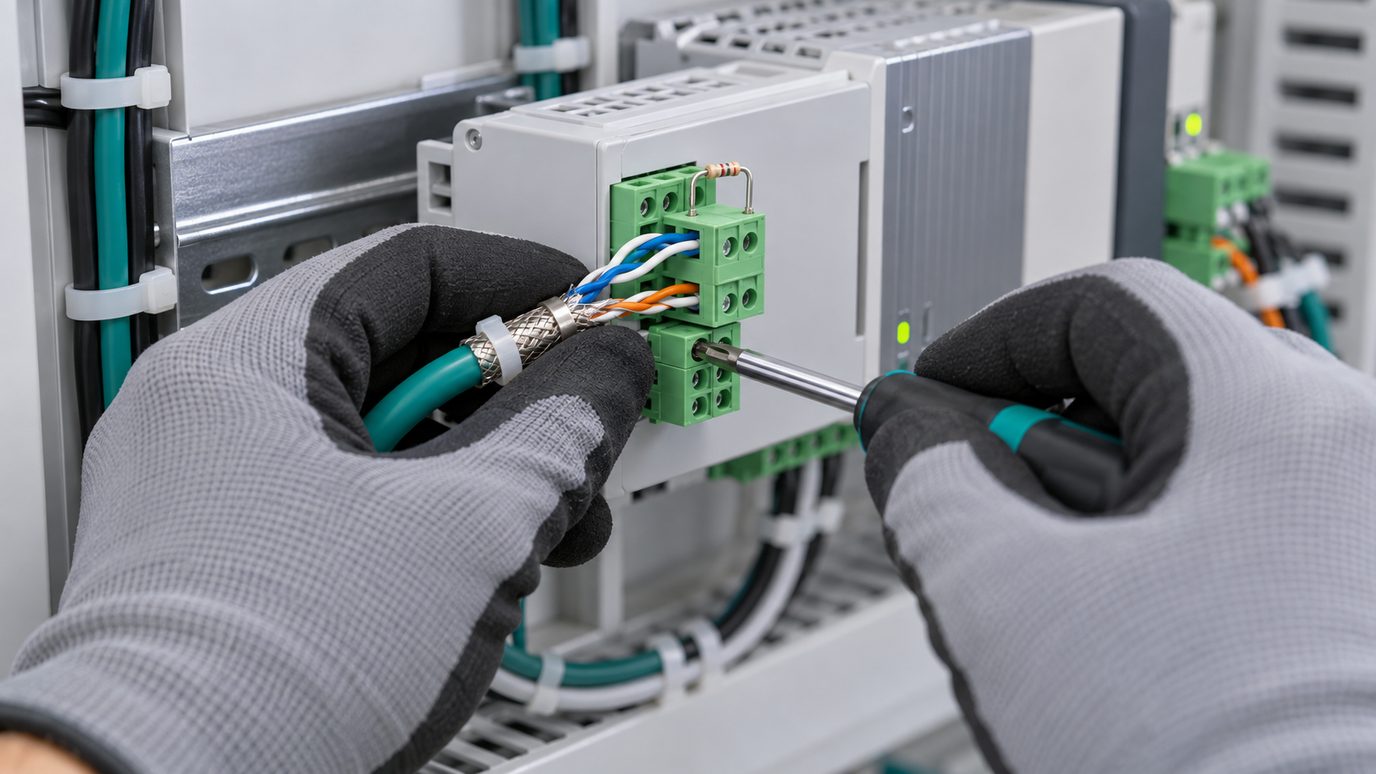
Most RS-485 faults are wiring faults. Use a daisy chain, terminate both ends, bias the line at one point and keep stubs short.
What RS-485 Is
RS-485 is a differential serial standard: data is carried as the voltage difference between two wires, so noise that hits both wires equally is rejected. It allows several drivers on one line with only one transmitting at a time. It defines the electrical layer only. Protocols such as Modbus RTU and BACnet MS/TP run on top.
Topology
Wire a daisy chain: the cable runs from device to device in a line, with stubs as short as possible. A star layout causes reflections and signal problems. Devices on the same trunk share the bus. Modbus RTU allows one master per line, and BACnet MS/TP passes a token among its masters.
Termination and Biasing
Fit a 120 ohm resistor at each physical end of the trunk to match the cable impedance and stop reflections. Termination can be unnecessary on short, slow runs, but it is crucial otherwise. An idle bus can float inside the receiver's undefined band of 400 mV, so add bias resistors, pull-up on one wire and pull-down on the other, at one node only, usually the master.
Cable and Shielding
Use twisted pair cable of about 120 ohm characteristic impedance, commonly 22 to 24 AWG. Shielded cable is recommended for noisy sites. Ground the shield as the device manual advises, commonly at one end to avoid ground loops, and connect the signal common according to the protocol you use.
Length, Speed and Loading
The standard allows 32 unit loads on a line, and transceivers with one-eighth unit load allow up to 256 nodes. A line can run about 1200 m (4000 ft) at 100 kbit/s or less, and speeds up to 10 Mbit/s are possible only on runs near 12 m (40 ft). Lower the baud rate before adding more cable.
Ground Differences
Remote devices on different supplies can have ground potential differences that add common-mode noise. The receiver tolerates a common-mode range of -7 V to +12 V. Where that is not enough, use isolated transceivers or isolated converters.
Common Questions
Do I need a termination resistor on RS-485?
Usually yes, 120 ohm at each end of the trunk. Short runs at low speed can work without it, but adding it is safer on any long or fast bus.
How many devices can I connect to one RS-485 line?
The standard allows 32 unit loads. Low-load transceivers allow more, up to 256 in the best case. Modbus RTU adds its own limit of one master and up to 247 addresses, with 32 devices per segment unless repeaters are used.
What is the maximum RS-485 cable length?
About 1200 m (4000 ft) at 100 kbit/s or lower. At 10 Mbit/s the cable is limited to about 12 m (40 ft).