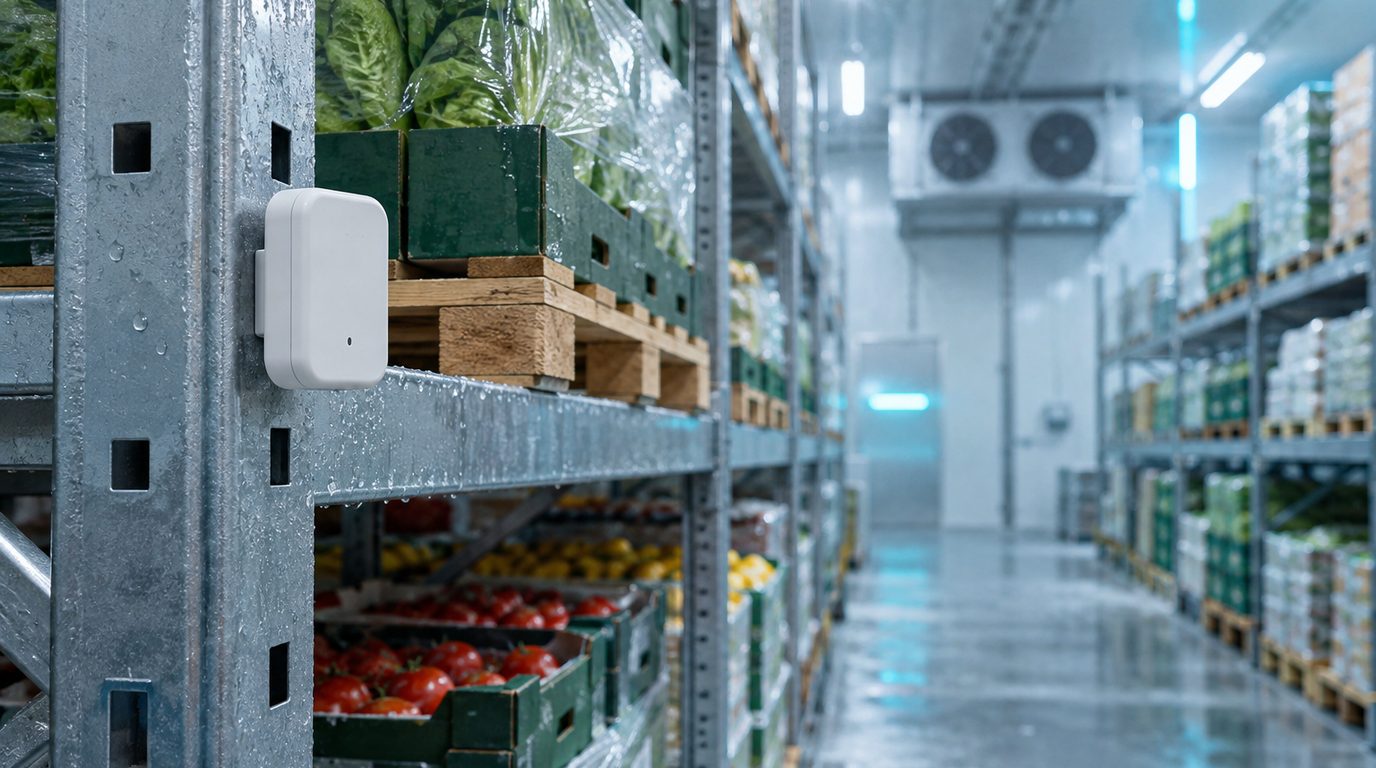
Cover the warmest corners and the door, alert with a delay so a door opening is not an excursion, and treat a silent sensor as a fault.
Placement
Temperature is not uniform in a cold room. Place sensors at the warmest points, usually near the door and high on shelves away from the evaporator, and one near the product itself. A single probe by the evaporator reads colder than the goods.
Interval and Wireless Choice
Cold rooms change slowly, so readings every few minutes are usually enough and save battery. LoRa sensors reach through walls and across a site; BLE suits dense rooms with a gateway nearby. Add a door contact so door events can be seen beside temperature.
Alerts Without False Alarms
A door opening causes a brief rise that recovers. Alert only when the temperature stays above the limit for a set time, and escalate if nobody acknowledges. Alert separately on rate of rise, which catches a failing compressor early.
Silent Sensors
A sensor that stops reporting looks like a stable room until the loss is found. Alert on missing readings, low battery and weak signal as faults in their own right.
Records
Keep a continuous history per sensor with timestamps and quality flags, and export it when audits ask. A gap in the record should show as a gap, never as a flat line.
Common Questions
How many sensors does a cold room need?
Enough to cover its warmest corners and its door, often two to four for a small room and more for a large store. Confirm with a short survey of readings before fixing the count.
Can IoTServa read the refrigeration controller too?
Yes, where the controller exposes Modbus or another supported protocol. Compressor status and power beside room temperature help explain an excursion.