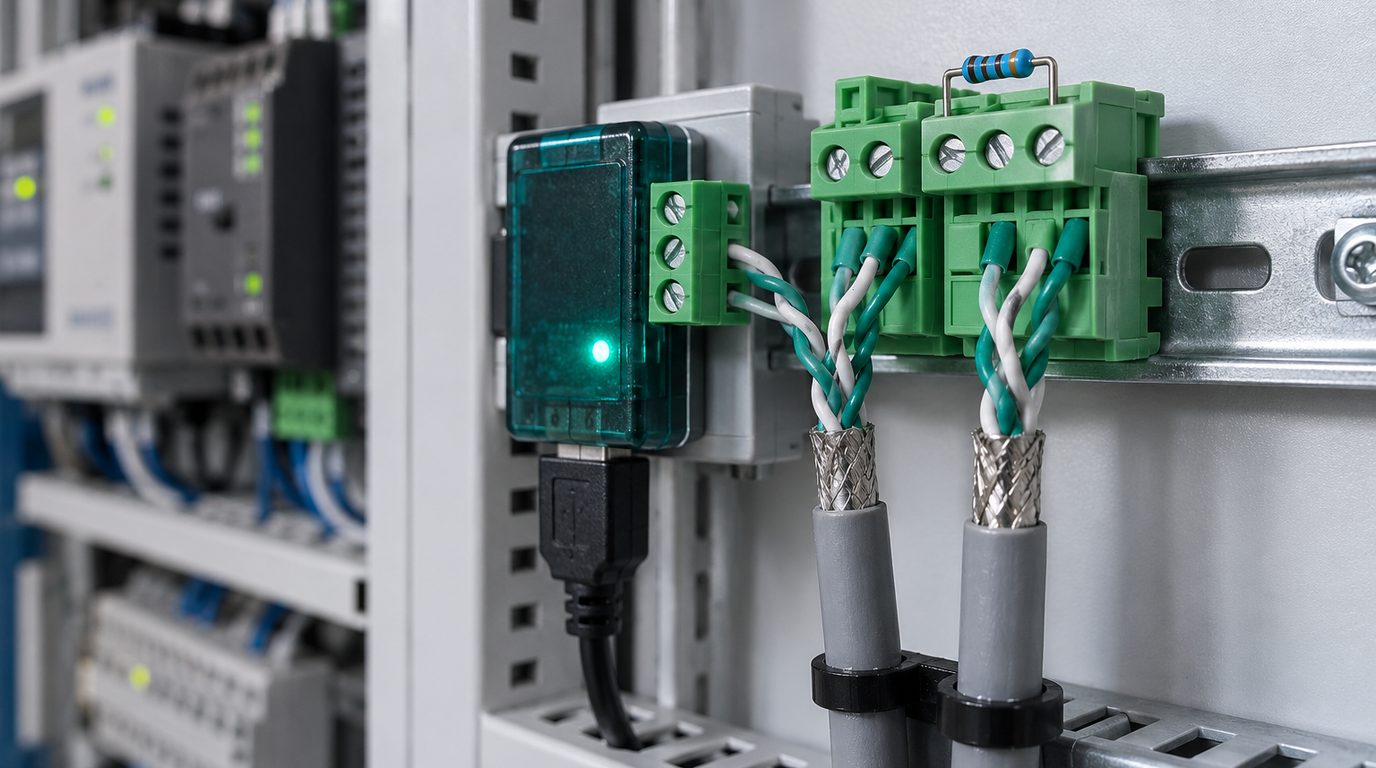
RS-232 connects two devices over short cable, RS-422 sends one driver to up to ten receivers, and RS-485 shares one line among many devices.
RS-232
RS-232 is single-ended and point-to-point, connecting only two devices. The standard limits cable capacitance to 2500 pF, which gives roughly 15 m, and longer runs are possible at low baud rates. It is found on older equipment, service ports and configuration cables.
RS-422
RS-422 is differential, with one driver and up to ten receivers on a line. It allows long runs and good noise immunity but is not a multi-master bus.
RS-485
RS-485 is differential and allows several drivers on one line, only one transmitting at a time, with up to 32 unit loads in the standard and more with low-load transceivers. It is the common choice for field buses and carries Modbus RTU and BACnet MS/TP.
Two Wire or Four Wire
RS-485 can be half duplex on one pair or full duplex on two pairs. Modbus uses two wires plus a common conductor as the usual option, with four wire as an optional variant.
Choosing and Converting
Pick the standard the device has. A USB to RS-485 or USB to RS-232 converter, or a gateway port, connects it to a computer. IoTServa reads serial devices through the edge gateway port, so the cable never has to reach the internet.
Common Questions
Is RS-485 the same as Modbus?
No. RS-485 is the electrical layer and Modbus RTU is a protocol commonly sent over it. RS-485 also carries BACnet MS/TP and vendor protocols.
Can I connect an RS-232 device to an RS-485 bus?
Not directly. Use an RS-232 to RS-485 converter, and remember that RS-232 is point-to-point, so each converter serves one device.